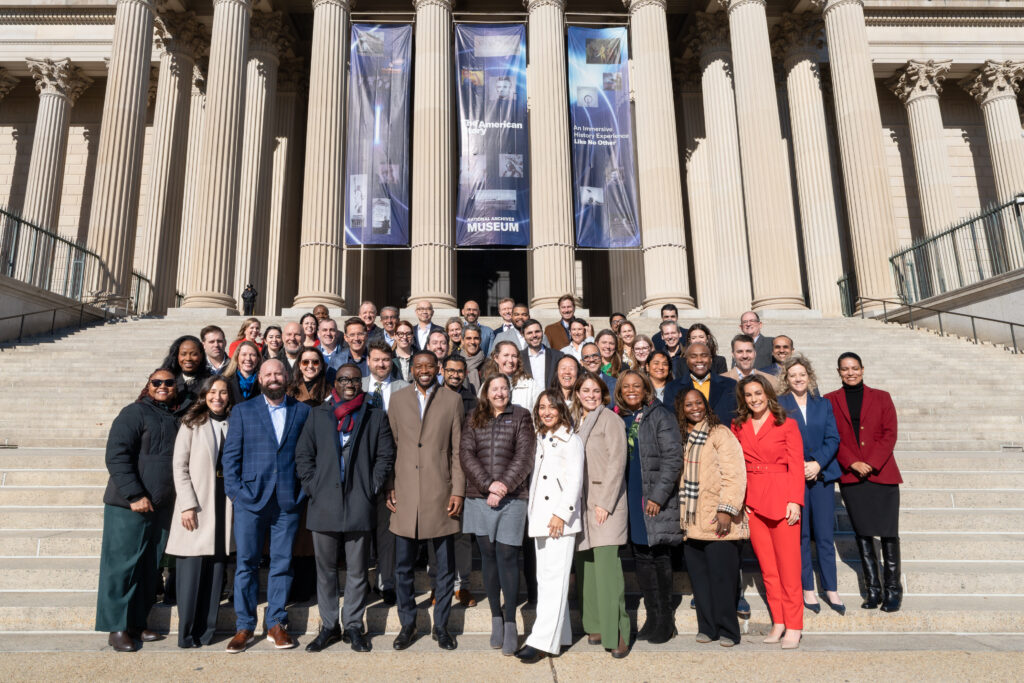

Something powerful happens when 58 leaders from across the country step into the same room for the first time – people from different sectors, ideologies, geographies, and life experiences united by a shared commitment to values-based leadership.
That’s how Module One of the Presidential Leadership Scholars Program began for members of the Class of 2026.
Before sharing titles, resumes, or professional accomplishments, Scholars were invited into a deeper conversation with these questions: “Who are you? Who are you here for? And what values show up in the way you lead?” This grounding in values is foundational to the program because we’ve seen that it brings people together and stands the test of time.
In Washington, D.C., Scholars were reminded that leadership is lived, tested, and ever changing in our Nation’s capital. Visits to the National Archives, the White House Historical Association, and the U.S. Capitol building reminded Scholars that values have always shaped the American story. Walking the halls where debate, disagreement, and deliberation happen every day, and seeing our founding documents in person, Scholars witnessed firsthand leadership in action.
In these spaces, they were reminded that leadership is a responsibility carried by people willing to show up with courage, humility, and a commitment to something larger than themselves.
However, the most meaningful parts of Module One didn’t happen at historic sites but in conversations.
Scholars gained insight about the power of storytelling in policymaking from Sue Urahn, president and chief executive officer of the Pew Charitable Trusts. She told them that although data enables leaders to evaluate issues and potential solutions, true achievements come when that research is contextualized through narratives about people’s lives.
And over meals, in small groups, and in late-night discussions, Scholars met others in their cohort whom they likely would never have encountered if not for the program. Those with different perspectives. Different lived experiences. Different approaches to leadership. Yet, through humility, honest dialogue, and shared reflection, they began building something essential: trust.
This is the quiet power of the Presidential Leadership Scholars Program. It creates space for leaders to listen deeply, to challenge assumptions, and to see the humanity in one another before anything else. It reminds Scholars that changemaking is not about winning arguments, but about building relationships strong enough to hold hard conversations.
By the end of Module One, members of the Class of 2026 left Washington not just inspired by history but energized by possibility. They saw that the values that shaped our nation are the same values that can shape their leadership today.
Fifty-eight professionals arrived in D.C. unsure what the next six months would look like. They left as Scholars, grounded in their values, connected through shared experience, and ready to step into their roles as trailblazers in their communities and across the country.
And this is only the beginning of their journey.
Casey Rodriguez is senior program manager of leadership programs at the George W. Bush Institute.